Our history
Our history
Initiative Milestones
ClimateScanner was launched in November 2022 during the XXIV International Congress of Supreme Audit Institutions (INCOSAI), held in Rio de Janeiro.
Painel ClimaBrasil, in turn, was launched in February 2025 during the “Chamado Brasil” event, which included the participation of Brazilian Courts of Accounts and took place at the Federal Court of Accounts (TCU) in Brasília.
The methodologies were developed collaboratively and help Audit Institutions in the challenge of tracking, evaluating, and monitoring government climate actions. Learn more:
Methodologies developed
The ClimateScanner methodology was created with the assistance of more than 70 auditors from Supreme Audit Institutions across different countries, with technical support from key international organizations.
It all began in November 2022, when the project was officially launched at a major international event. After that, an Executive Group (EG) was established, led by SAI Brazil and comprising 18 Supreme Audit Institutions from around the world, plus Brazil’s Office of the Comptroller General (CGU).
The EG was responsible for developing the assessment tool. For this purpose, its members were organized into four teams, each focusing on a specific theme: Governance, Public Policies, Finance, and Capacity Building.
During 2023, the EG met several times, and by the end of the year, the methodology was ready to be applied:
- February: An initial remote meeting was held to organize activities.
- May: An in-person workshop took place in Brasília, Brazil, where participants discussed and advanced the development of the methodology.
- July: In an important meeting in Foz do Iguaçu, Brazil, institutional leaders approved the main ideas of the tool. During this event, a global survey was launched to understand how institutions were already conducting climate audits and what training would be necessary. The survey received responses from 104 institutions.
- November: The methodology was finalized and presented to the public at COP 28.
- Following this: The EG began preparing the manual and planning the training program to ensure the tool would be used correctly and consistently (read more about the materials developed and the training phase in the side panels).
 Brazil
 India
India Philippines
 Canada
 Kenya
Kenya Thailand
 Colombia
 Maldives
 United Arab Emirates
 European Court
of Auditors
European Court
of Auditors Morocco
 United Kingdon
 Finland
 New Zealand
 United States
2024 was the year when the ClimateScanner methodology was widely shared with auditors from Supreme Audit Institutions, but you can read that story in the side panel.
The year 2025 marked the adaptation of the ClimateScanner to the Brazilian context:
- January to March: Weekly remote meetings were held with a hired specialist to develop a draft methodology proposal.
- March: The first version of the methodology adapted to the Brazilian context was delivered, and named “Painel ClimaBrasil.”
- April: The final version of the Painel ClimaBrasil methodology was validated in a remote meeting with representatives from Brazilian Courts of Accounts, after receiving contributions and adjusting the text.
- May: The Painel ClimaBrasil Application Manual was finalized, and the methodology was disseminated to auditors from Brazil’s Courts of Accounts (read more about this phase in the side panels).
Tools developed
To develop the concept, build and share the methodologies, engage audit institutions, international organizations, non-governmental organizations, and auditors, as well as to communicate the results achieved, various strategies and tools have been adopted and created. The main ones are listed below:
- Assessment Tool and Application Handbook
The methodologies were designed based on three pillars:
- Assessment Tool: Defines what should be assessed.
- Application Handbook: Establishes the scope of the evaluations.
- Web Application: Collects the evaluation content from each audit institution and generates graphs and reports.
Web Applications
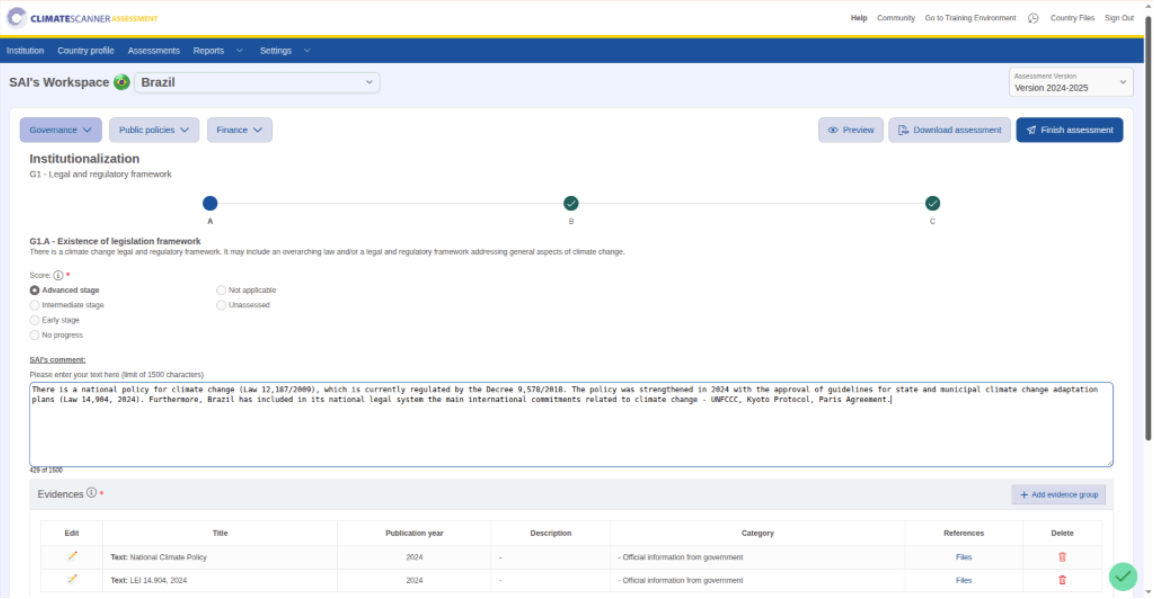
Web Applications were developed using Apex technology to ensure information security, simplify data consolidation, and generate reports and results in the form of graphs.
Training Materials
Many educational materials were developed to support the dissemination of the methodologies:
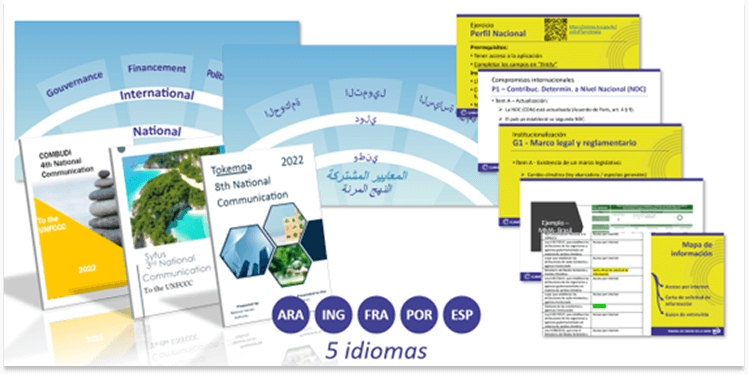
- PowerPoint Presentations: Containing content for the planned sessions, translated into five languages (English, French, Arabic, Spanish, and Portuguese).
- Documents from Fictional Countries and Subnational States: Prepared to facilitate practical exercises during workshops.
- Training Version of the Applications: Created to familiarize auditors with the technological environment and enable them to complete the planned practical exercises during the workshops.
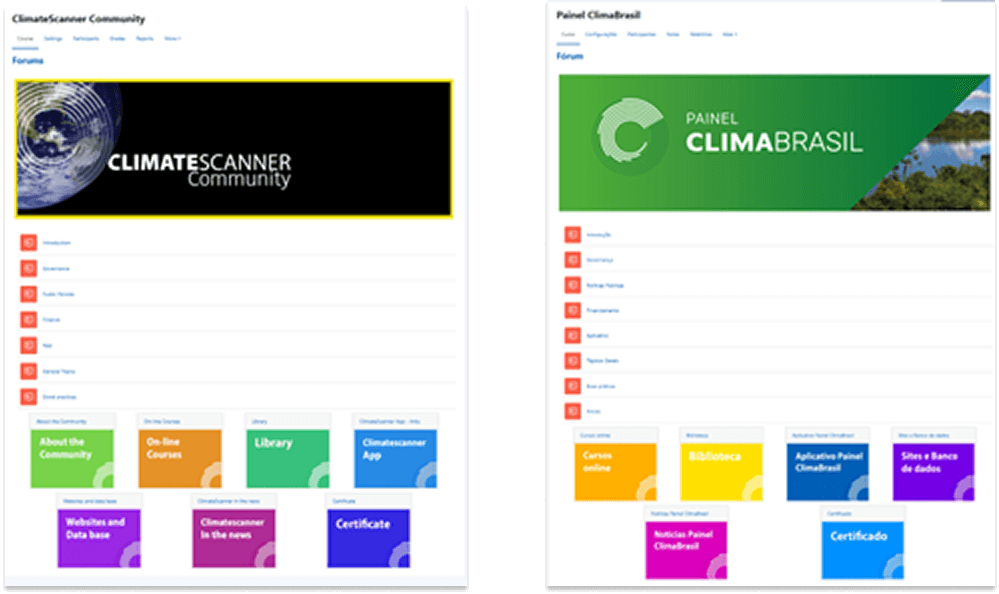
ClimateScanner and Painel ClimaBrasil Communities
To centralize materials and provide a space for collective learning, two areas were created on the Moodle training platform. These communities include, among other features:
- Thematic Discussion Forums
- Suggestions for Courses on Climate Change
- Library: Containing workshop materials and additional resources.
Adherence Analysis
To support the work of audit institutions and reduce the risk of assessments that are unbalanced or not aligned with the methodologies, the initiative’s coordinating team developed the “Adherence Analysis,” a tool:
- Created using Artificial Intelligence (AI)
- Based on the three pillars of the methodology: Assessment tool, application manual, and web application.
- Made available for review and consideration by participating audit institutions
Communication Materials
Effective communication has been a key element in promoting the initiative and its results. Among the materials produced, the following stand out:
- Visual Identity
- Banners, Cover Pages, Slide Templates
- Infographics, Brochures, Booklets, Leaflets
- Videos, Short clips
- Website
Dissemination of the methodology
To ensure proper application of the methodologies, seven regional capacity-building workshops were conducted for the Supreme Audit Institutions (SAIs) participating in ClimateScanner, along with one workshop for Brazilian Courts of Accounts.
The goal was to build auditors’ capacity to use the assessment tools effectively. These training sessions were essential for preparing auditors and aligning evaluation criteria, fostering a more consistent understanding of the methodology and balanced assessments.
How the process unfolded:
- Planning Phase (Late 2024 to March 2025):
- Capacity-building actions were planned.
- The format included:
- 5 days of in-person meetings
- Morning and afternoon sessions
- Presentations by climate change experts
- Theoretical presentations on the methodology
- Pratical exercises using both real and fictional data
- In-person Workshops (April 2024 to May 2025):
- Seven Regional Workshops in 2024:
- 141 Supreme Audit Institutions.
- Conducted in Spanish or English.
- With translation into French, Arabic, and Portuguese, as required.
- Materials produced in English, Spanish, French, Arabic, and Portuguese.
- One In-person Workshop in 2025:
- 32 Brazilian Courts of Accounts
- Conducted in Portuguese
- Seven Regional Workshops in 2024:
Workshops held
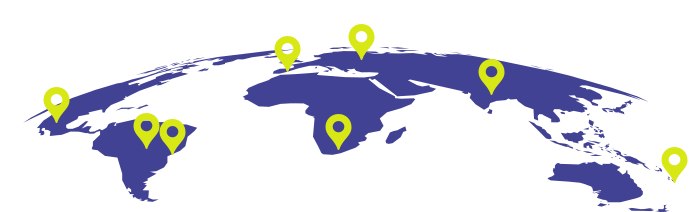
- OLACEFS – Mexico City, April 2024
- PASAI & CAROSAI – Nadi, June 2024
- EUROSAI – Praha, July 2024
- ARABOSAI & CREFIAF – Rabat, July 2024
- ASOSAI – Jaipur, July 2024
- AFROSAI-E & CPLP (English and Portuguese) – Pretória, July 2024
- Last Call – Rio de Janeiro, October 2024
- Local Action, Brazil – Brasilia, May 2025
institutions
Timeline
Check the timeline and key milestones of the initiative, from its conception to the presentation of results at COP 30.
2022 Planning
Outreach and networking
Official launch (XXIV INCOSAI, Rio, Nov/22)
2023 Design
Framework design
Global Survey
Pilot tests
COP 28
2024 Training and assessment
Global Call
Regional workshops
Assessments
COP 29
2025 Consolidation
Adaptation at the subnational level
Workshop (Painel ClimaBrasil)
National and global consolidation
XXV INCOSAI
COP 30
And the work continues…
ClimateScanner and Painel ClimaBrasil mark an important milestone in the role of audit institutions in addressing climate change. These Institutions contribute to improving public management, enhancing transparency in government climate actions, and strengthening international cooperation. These initiatives establish Supreme Audit Institutions (SAIs) and Courts of Accounts (TCs) as agents of change in tackling global climate challenges.
This collaborative effort has inspired audit institutions to incorporate climate change into their control agendas, transforming the landscape by introducing a new player committed to addressing the climate crisis.
In Brazil:
ClimateScanner has brought significant progress to the country. It encouraged SAI Brazil to plan audits, such as the one conducted in 2024 on climate governance and led to the creation of the Painel ClimaBrasil, which expanded the initiative’s impact to the local levels, where problems occur, and public policies need to be implemented.