About

The project
ClimateScanner and Painel ClimaBrasil are two methodologies that have been developed to evaluate and monitor government actions to address climate change.
ClimateScanner was the first initiative. Developed by the International Organization of Supreme Audit Institutions (INTOSAI), under the leadership of the Brazilian Federal Court of Accounts (TCU), it focuses on the actions of national governments worldwide.
Painel ClimaBrasil, established in 2025, aims to assess the climate actions of state and municipal governments in Brazil. Inspired by the ClimateScanner, it was jointly developed by Brazilian audit institutions.

Who are the evaluators?
The evaluation is carried out by auditors from the audit institution responsible for assessing each entity. These institutions are independent public bodies that oversee the use of public resources and evaluate the performance of public policies. For example, the Costa Rican government is evaluated by auditors from the Office of the Comptroller General of Costa Rica (SAI Costa Rica). Conversely, the Rio de Janeiro city government is evaluated by auditors from the Court of Accounts of the Municipality of Rio de Janeiro (Brazil).
These audit institutions primarily ensure that public funds are managed transparently, correctly and efficiently. They also contribute to improving government policies and programs, and promote accountability among public managers.
These institutions possess key characteristics within the global context. For example, their independence ensures impartiality in their evaluations. Furthermore, they provide information based on detailed analyses and reliable evidence.
What does the assessment involve?
The ClimateScanner and Painel ClimaBrasil methodologies were developed collaboratively and are based on common criteria. They adopt a flexible approach, enabling them to be adapted to the specific characteristics of each entity being assessed (each country for ClimateScanner and each state or municipality for Painel ClimaBrasil).
ClimateScanner
The ClimateScanner methodology is structured into three axes, with 19 components divided into 62 items:
Governance Axis
Governance refers to how a government is directed and managed. To tackle the climate crisis, every country needs a well-structured governance system. This system should help governments address climate changes challenges—either by reducing greenhouse gas emissions or by adapting to the impacts of these changes.
Good climate governance depends on several factors, such as:
-
- National frameworks and legislation
- Planning and coordination between different sectors
- Monitoring of implemented actions
- Transparency in decisions and results
- Engagement of different groups
The components and items included in this axis are:
Public Policies Axis
Public policies encompass all actions a government chooses to do—or not to do. The climate crisis requires a strong and urgent response from all countries. Governments play a vital role in this process, leading public policies to reduce greenhouse gas emissions and adapting their territories and populations to new conditions.
To address these challenges, it is essential to assess each country’s public policies. This includes:
- The international commitments it has made
- Overall strategies for mitigation (emissions reductions) and adaptation (adjusting to climate change)
- The most relevant sectoral actions
The components and items included in this axis are:
Finance Axis
Climate finance refers to the funds allocated to support actions that address climate change. These funds can come from local, national, or international sources and may include both public and private resources.
The ClimateScanner evaluates various aspects related to climate finance, such as:
- How much countries invest from their own resources
- Whether developed countries are meeting their commitment to support developing nations
- Whether developing countries are prepared to access available resources
- Whether governments are mobilizing private funding for climate action
The components and items included in this axis are:
Painel ClimaBrasil
The Painel ClimaBrasil methodology, in turn, is an adaptation of the ClimateScanner framework to the Brazilian context. It is also structured into three axes, which are divided into 15 components and 45 items.
Governance Axis
The components and items included in this axis are:
Public Policies Axis
The components and items included in this axis are:
Finance Axis
The components and items included in this axis are:
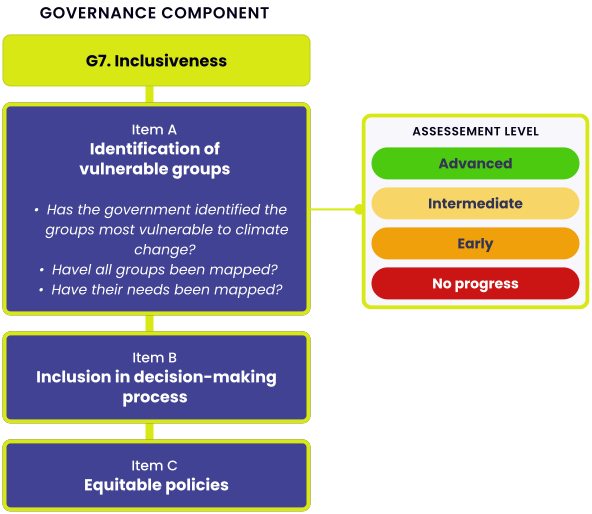
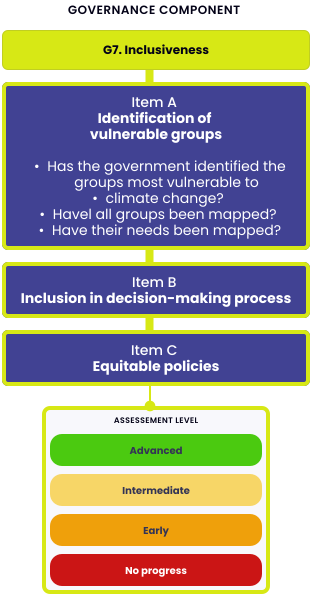
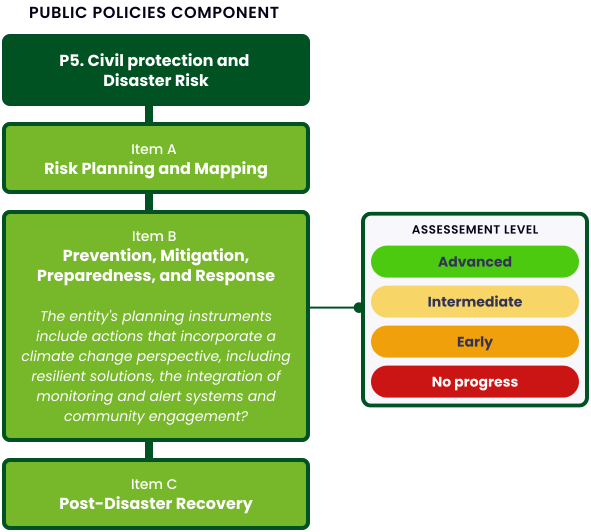
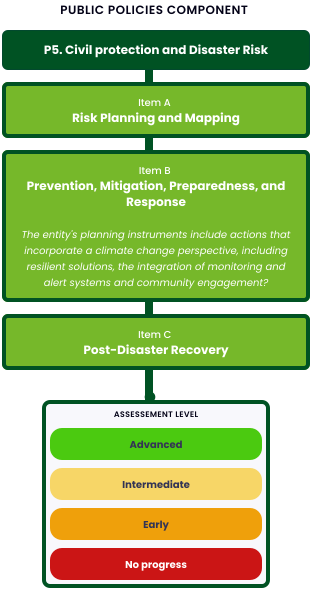
In both methodologies, each item represents a specific aspect of the corresponding component and is assessed by auditors on a four-level scale, according to the degree of progress achieved: advanced, intermediate, early, and no progress. Examples:
ClimateScanner
Painel ClimaBrasil
To determine the level, auditors carry out audit procedures such as surveys, interviews, technical analyses, and data collection. These procedures help verify whether there is evidence – such as laws, documents, or official statements – that support compliance with the aspects being assessed.
It is important to note that ClimateScanner and Painel ClimaBrasil do not analyze whether climate policies are being properly implemented or whether they are effective. Instead, they assess whether there are structures, plans, and resources allocated for climate actions.